The 2026 BFCM Seller Preparation Guide
How to choose products, protect your margins, prepare fulfillment & use AI before holiday traffic arrives
Black Friday and Cyber Monday can make an average week look unusually good. They can also expose every weak point in an ecommerce business at once.
A product that looked profitable in October can lose money after a discount, shipping, payment fees, returns and rising ad costs. A supplier delay can turn a strong sales weekend into two weeks of customer-service problems. A store that works perfectly on a laptop can still lose mobile shoppers because the offer is unclear or checkout takes too long.
That is why the best BFCM plan is not simply “run a bigger sale.” It is a short operating plan that connects product selection, pricing, fulfillment, creative, email and customer support before the traffic arrives.
The opportunity is still enormous. The National Retail Federation forecasts $1.013 trillion in US retail spending during November and December 2026, up 4.2% from 2025. Adobe expects ecommerce to account for roughly one out of every four dollars spent on retail goods during the holiday season. Adobe also expects discounts to deepen throughout November, reaching their highest levels during Cyber Week.
In other words, shoppers are ready to buy, but they are actively comparing value. Sellers need a strong offer and a store that can actually deliver it.
This guide covers the practical work I would complete before launching a BFCM campaign, including how I would use Doba’s Annual Super Sale and Doba Pilot to shorten the research and operational workload.
1. Start with a product scorecard, not a “winning product” label
The phrase “winning product” gets thrown around too easily. During BFCM, a product needs more than a good demonstration or a viral video. It needs to survive a promotion.
Before I add any product to a holiday shortlist, I score it against seven questions:
1. Is there an obvious reason to buy it now? Gifts, winter problems, holiday hosting,
home organization and seasonal décor all have built-in timing.
2. Can someone understand it in a few seconds? The benefit should be clear in an
image or the opening seconds of a video.
3. Is there enough room for a real offer? A discount is only useful if the remaining
contribution margin still makes sense.
4. Can the supplier support the expected volume? Current inventory, variant availability and processing time matter more than a promising thumbnail.
5. Can it arrive when the customer expects it? Seasonal products have a hard deadline. A Christmas item delivered after Christmas has almost no value.
6. Can I create several credible ad angles? One product should support multiple hooks, audiences and formats.
7. Can it keep selling after Cyber Monday? The best holiday tests can move into gifting, New Year or evergreen positioning instead of disappearing after one weekend.
A product does not have to score perfectly in every area. But the gaps should be visible before money is spent on listings and ads.
2. Use Doba’s Annual Super Sale as a research shortcut
Doba’s Annual Super Sale runs from November 11 through December 31, 2026, with savings of up to 60% on selected products and collections. The word “selected” matters. This is not a flat discount across the entire catalog, and the highest discount should not automatically determine what you sell.
The useful part of the sale is how the products are organized. Instead of starting with a blank search bar, sellers can browse four different research paths:
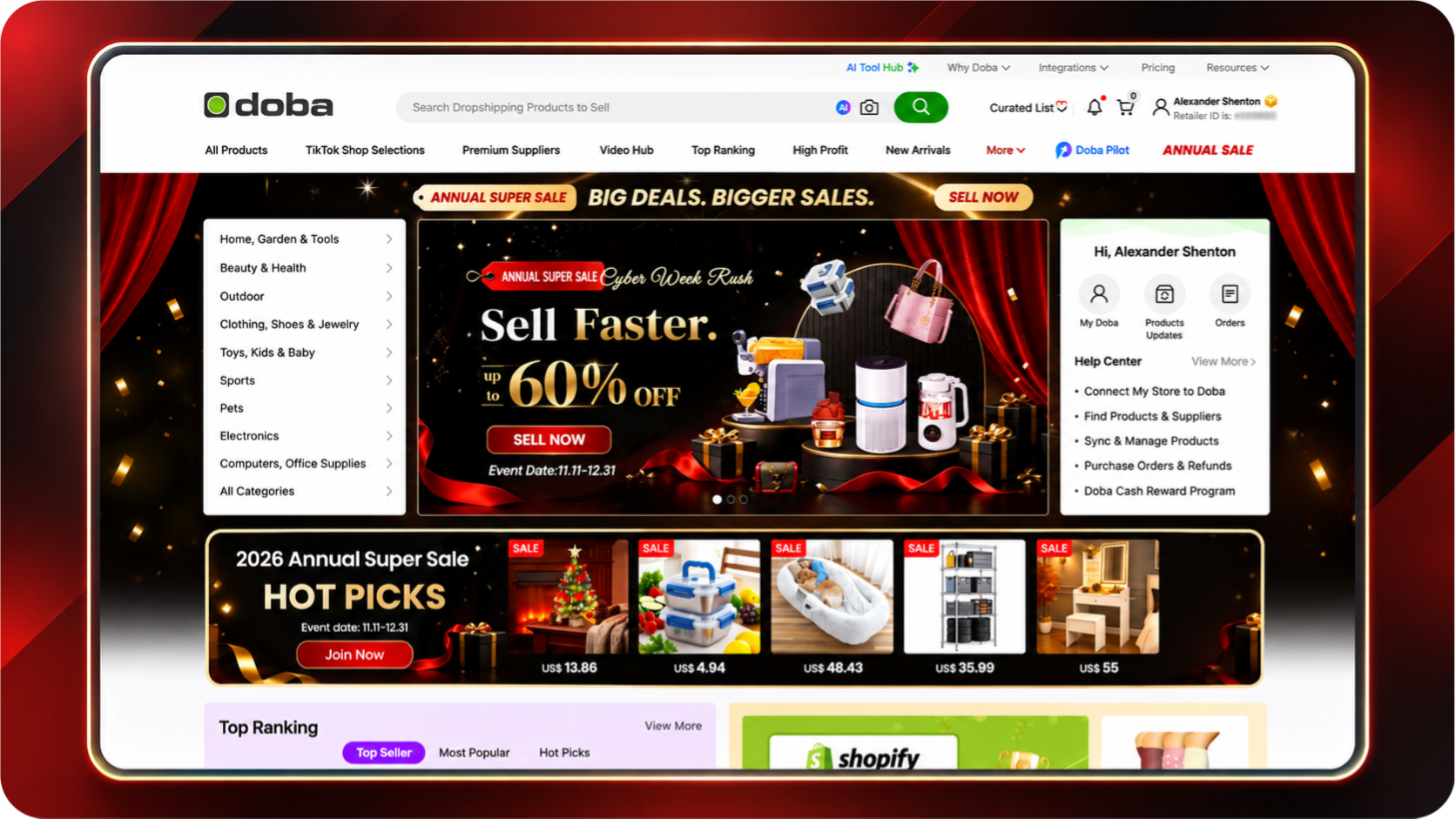
Doba’s Annual Super Sale organizes promotional products into focused research paths rather than one long discount feed.
Holiday Hot Picks
This collection is built around seasonal demand and proven product categories. It is a good starting point for gifts, hosting, décor and products with a clear holiday use case. Products in this section may also include return-support details, but the exact policy should always be checked on the live listing.
High Profit Hub
This section highlights products with stronger potential gaps between Doba pricing and marketplace comparisons. Treat those figures as research signals, not guaranteed net margins. Your real numbers still need to include shipping, platform fees, discounts, returns and advertising.
Supplier Collection
This is useful when supplier consistency matters as much as the product itself. You can browse featured suppliers by best sellers, new arrivals, holiday gifts, high-margin items and seasonal releases, then compare the operational details behind each option.
Business Solutions
These collections are organized around store directions such as Holiday Gift Business, Home Office Business, Pet Store Essentials, Small Space Living, Kitchen Starter Collection and Fitness Business. That makes it easier to build a related assortment instead of filling a store with disconnected products.
The sale page gives you a faster starting point. The final decision still comes from the product page.
For every candidate, I would verify:
- the exact variant and current product cost.
- available inventory.
- shipping cost and destination.
- order processing time and estimated delivery time.
- return terms.
- supplier information.
- product images, specifications and claims.
- whether the numbers still work after the planned BFCM offer.
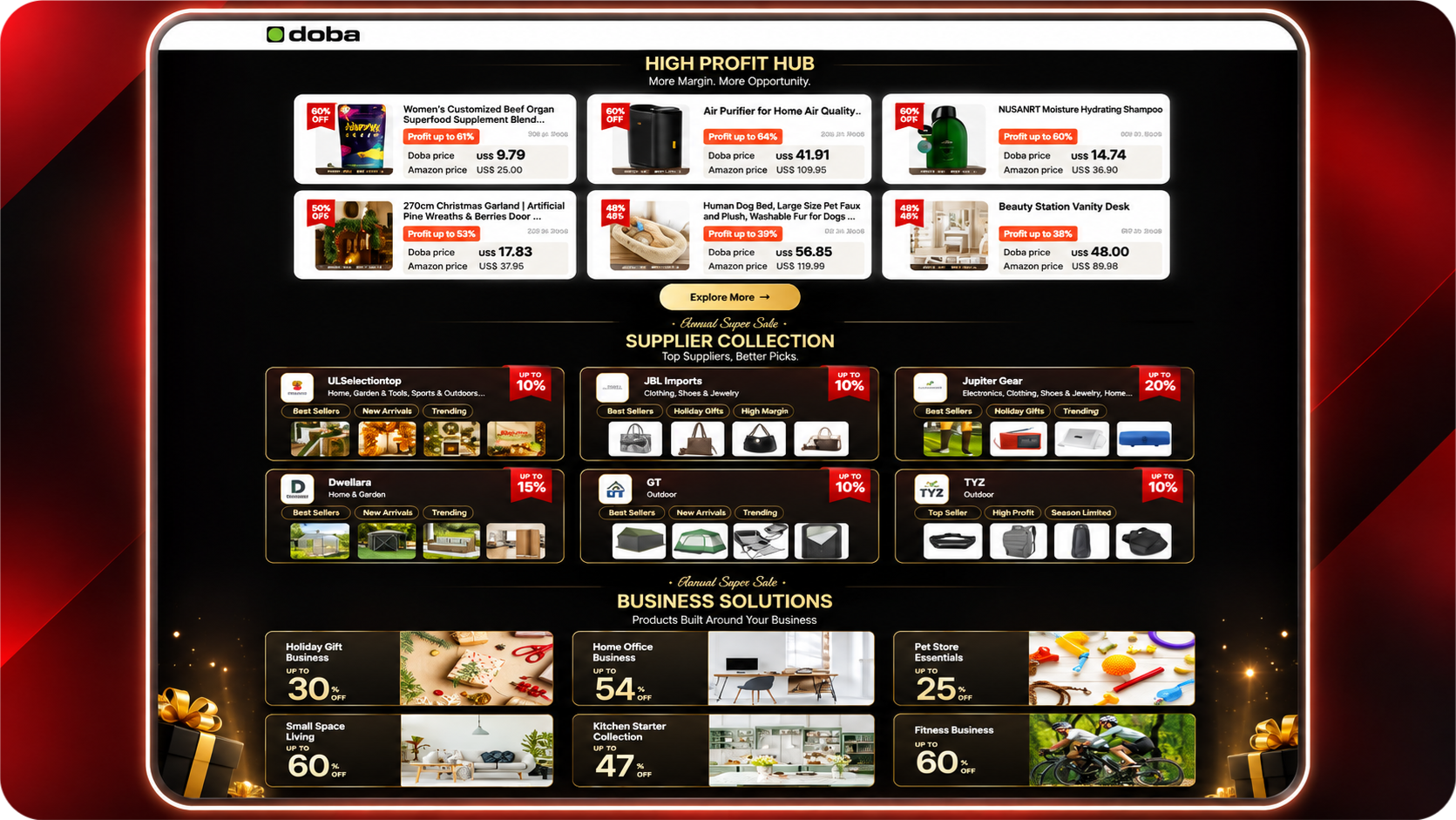
The Supplier Collection and Business Solutions sections make it easier to research by supplier, store direction or customer need.
3. Five product opportunities worth researching
These are not automatic winners. They are examples of how I would turn the Annual Super Sale into a focused BFCM shortlist. Pricing, inventory, discounts and shipping can change, so the live Doba listing should be the final source before a product is published.
1. Christmas garland and seasonal décor
The Annual Super Sale includes a 270 cm artificial Christmas garland in the High Profit Hub. Holiday décor has an immediate visual hook and a clear deadline, which makes it easy to demonstrate in short-form content.
The strongest creative angle is a transformation: an empty staircase, mantel or doorway becomes holiday-ready in a few seconds. This category can also support bundles with table
décor, lights or other coordinated items.
The risk is timing. I would set a conservative order cutoff based on the supplier’s processing and delivery estimates, then display that date clearly on the product page and in campaign emails.
2. Stainless steel food storage containers
Holiday hosting creates demand for meal preparation, leftovers, pantry organization and transporting food. The stainless steel container set currently appears in Holiday Hot Picks, giving it a useful seasonal angle without making it a one-month product.
Creative can move from a crowded refrigerator to a clean system, compare reusable storage with disposable containers, or show a complete holiday meal-prep routine. After the holidays, the same product can shift into January organization and meal-prep messaging.
That longer selling window makes it especially interesting. The product is not dependent on one shipping deadline or one holiday moment.
3. Five-tier storage shelving
Storage products fit several Q4 behaviors at once: preparing the house for guests, organizing seasonal supplies, making room for new purchases and resetting the home before January.
The Annual Super Sale currently features a five-tier steel shelving unit. The advertising opportunity is straightforward before-and-after content. A garage, pantry, office or utility room gives the product an obvious problem to solve.
For a larger item like this, shipping cost and damage risk deserve extra attention. I would check the destination-specific delivery cost, packaging details and return process before deciding on the retail price.
4. Air purifier
An air purifier can be positioned around indoor winter living, pet dander, smoke, dust and bedroom comfort. It also has a strong visual story when paired with a clear use case, even though the product’s benefit is less visible than a storage transformation.
The Annual Super Sale’s High Profit Hub currently includes an air purifier with air-quality sensing and an automatic mode. For this category, the listing and ads should stay close to verified product features. Avoid medical claims and focus on the functions shown by the supplier.
This is another product that can continue after BFCM. It fits gifting, winter home care and evergreen household campaigns.
5. Pet comfort products
Pet owners buy for their animals throughout the year, and holiday gifting gives the category another reason to purchase. Doba’s Business Solutions area includes Pet Store Essentials, while the High Profit Hub currently features a large human-and-pet bed.
The visual angle is strong: comfort, size, washable material and the shared use case can all be demonstrated. Before testing, I would check the item’s dimensions, package size, shipping cost and return terms carefully. Bulky products can look attractive on the front end while carrying more fulfillment risk behind the scenes.
4. Build the offer from the bottom up
The biggest BFCM mistake is choosing the discount first and checking the margin later.
Start with this simple calculation:
Selling price − product cost − shipping − platform and payment fees − discount − returns reserve − advertising cost = contribution margin
Run the calculation at the actual sale price, not the regular price. Then test a few offer structures instead of assuming the deepest percentage wins.
Possible structures include:
- a direct percentage discount
- a fixed amount off above an order threshold
- a bundle with a higher average order value
- buy more, save more
- a free gift that costs less than a larger discount
- free shipping above a threshold
- early access for email and SMS subscribers.
A clean 15% offer with healthy economics can be better than a dramatic 40% discount that leaves no room for acquisition costs or returns.
I also separate the customer-facing promise from the internal goal. “Save 20% on holiday organization” is the promise. “Increase average order value with a two-unit bundle” is the operating goal. The offer has to make sense from both sides.
5. Prepare fulfillment before the campaign goes live
Product cost gets most of the attention during research, but holiday customer experience depends on fulfillment.
For each promoted item, create a small fulfillment sheet with:
- supplier and warehouse location
- live inventory and important variants
- order processing time
- estimated delivery range by market
- last recommended order date for holiday arrival
- return instructions
- backup product or supplier, if one is available
- customer-service response for a delay or stockout.
Processing time and delivery time are not the same thing. If a supplier needs three business days to process an order, that time comes before the carrier’s delivery estimate.
Place a test order when possible. It is the fastest way to check packaging, tracking updates, product quality and the real delivery experience before volume increases.
Finally, keep the language on the product page realistic. If holiday delivery is not guaranteed, do not present an estimate as a guarantee. A slightly more conservative promise is usually easier
to recover from than an ambitious one that fails.
6. Build the pages and creative before the rush
BFCM traffic is expensive. Product pages need to answer the customer’s questions without forcing them to hunt.
At minimum, I would review:
- the offer and end date above the fold
- mobile page speed
- product benefits and specifications
- delivery estimate and holiday cutoff
- return policy
- reviews or other proof that can be used accurately
- FAQs for sizing, compatibility, materials or care
- discount behavior at checkout
- abandoned-cart and order-confirmation messages
Then I would prepare at least three creative directions per product:
- Problem and solution: lead with the specific frustration the product fixes.
- Demonstration or transformation: show the product working or the before-and-after result.
- Holiday context: gifting, hosting, winter routines or getting the home ready.
Each direction can produce several ads by changing the first three seconds, headline, creator, format or offer. That gives the campaign new inputs without rebuilding the strategy every day.
7. Map the customer journey beyond the first purchase
BFCM does not end when someone clicks “buy.” New customers should enter a simple retention plan while the brand is still fresh in their mind.
A practical email and SMS sequence could include:
- Early access: reward existing subscribers before the public launch
- Launch: state the offer and lead with the strongest product or collection
- Product proof: show the use case, demonstration, reviews or FAQ answers
- Reminder: focus on the offer deadline or holiday delivery cutoff
- Last chance: send only when the deadline is real
- Post-purchase: set expectations, share tracking and explain product use
- Cross-sell: recommend a relevant add-on after the first order has had time to arrive
- December transition: move from Cyber Week language into gifting and shipping-deadline messaging.
The goal is to avoid treating every subscriber the same. Existing customers, engaged browsers, cart abandoners and brand-new subscribers have different reasons to act.
8. Use Doba Pilot to take repetitive work off the calendar
The week before BFCM is not when a seller wants to spend hours copying product details between tabs or manually checking every order.
Doba Pilot can support several parts of the workflow inside Doba:
- use Market Scout to research demand, competition and seasonality
- turn a market direction into sourceable Doba products
- compare product, supplier, inventory and shipping information
- prepare optimized product titles and descriptions
- create and publish listings to supported channels
- schedule recurring research or operational tasks
- check recent orders for fulfillment issues
- pull together the details of a delayed shipment, missed pickup or refund and prepare the next step for review
The seller still makes the important decisions. Product samples, pricing, claims, customer promises and major order actions should receive a normal business review. The value of Pilot is that it can assemble the information and complete supported tasks while the seller stays focused on the parts that require judgment.
Here are four practical prompts to start with:
“Use Market Scout to find three holiday product categories with rising demand, manageable competition and selling potential beyond December. Explain the tradeoffs of each.”
“Search Doba’s Annual Super Sale for products that fit a holiday hosting store. Compare current cost, inventory, supplier, processing time, shipping and return information.”
“Prepare a listing for this product for my connected store. Keep every claim tied to the supplier information, write a clear title and description, and show me the draft before publishing.”
“Check my recent orders for delayed shipments, missed carrier scans, cancellations or refund issues. Summarize what needs attention and prepare the recommended next step for my review.”
That division of labor is useful during the holidays: Pilot handles research, comparison and routine checks; the seller handles the final call.
A 14-day BFCM preparation plan
Days 14–11: Research and economics
- Browse the Annual Super Sale and build a shortlist.
- Run each product through the scorecard.
- Verify current inventory, cost, shipping and return terms.
- Calculate contribution margin at the planned sale price.
- Order samples for the strongest candidates where practical.
Days 10–8: Offer and storefront
- Choose the offer structure.
- Prepare or update listings.
- Add delivery estimates, cutoff dates and FAQs.
- Test the discount, checkout and confirmation messages on mobile.
- Build one backup offer in case the first one underperforms.
Days 7–5: Creative and retention
- Produce at least three creative directions per featured product.
- Prepare email and SMS segments.
- Build early-access, launch, reminder and post-purchase messages.
- Check tracking, analytics and attribution links.
Days 4–1: Operational checks
- Reconfirm inventory and supplier details.
- Review processing and delivery estimates.
- Place a test order through the full checkout flow.
- Prepare customer-service responses for delays and stockouts.
- Schedule the first campaign messages and ad launches.
During BFCM
- Watch contribution margin, not revenue alone.
- Track inventory and fulfillment exceptions.
- Increase spend on proven ads carefully.
- Pause weak ads and introduce new hooks.
- Keep delivery promises and cutoff dates current.
- Log common customer questions and update the product page.
After Cyber Monday
- Move holiday-appropriate winners into December campaigns.
- Shift evergreen products toward gifting, winter routines or New Year organization.
- Review returns, cancellations and customer-service issues by product.
- Save the strongest creative and offer findings for the next promotion.
The daily BFCM command center
During the sale, I would review these numbers and issues at the same time every day:
- revenue and contribution margin
- spend, cost per acquisition and return on ad spend
- conversion rate and average order value
- live inventory on promoted products
- delayed or canceled orders
- refund and return requests
- customer-service volume
- email and SMS revenue
- the strongest and weakest creative
- the next action required before the following day
That 20-minute review keeps small problems from becoming expensive ones. It also stops the team from reacting to revenue screenshots while ignoring margin or fulfillment.
A smarter way to use the sale
Doba’s Annual Super Sale is most useful when it shortens the path from a broad holiday idea to a product that has passed a real business check. Start with the curated collections, verify the
live details, calculate the economics and make the customer promise only after the fulfillment path is clear.
From there, Doba Pilot can help with the repetitive work around research, sourcing, listings and order checks. That gives the seller more time for the decisions AI should not make alone: the offer, the creative, the customer experience and where to place the next dollar.
Explore Doba’s Annual Super Sale & Doba Pilot
If you already know other sellers who would benefit from Doba, the company is also running a limited affiliate campaign from November 4 through December 31, 2026. Eligible affiliates can
earn additional cash rewards for qualifying new paid retailer referrals on top of their regular commission. Check the official campaign terms and eligibility details before sharing a referral
link.
Sources and further reading
- National Retail Federation, “NRF Forecasts 2026 Holiday Sales Growth as Consumers
Remain Resilient”:
https://nrf.com/media-center/press-releases/nrf-forecasts-20... - Adobe, “2026 Holiday Shopping Trends, Statistics & Forecast”:
https://business.adobe.com/resources/holiday-shopping-report... - Shopify, “Black Friday Checklist 2026: 25 BFCM Prep Steps”:
https://www.shopify.com/blog/bfcm-checklist