Try This Prompt |
|---|
“Analyze the U.S. market for pet travel accessories between $30 and $80. Compare demand, competition, seasonality, pricing, and the customer problems most likely to produce strong demonstration-style content. Then suggest three product directions worth investigating. Do not call anything a guaranteed winner.” |
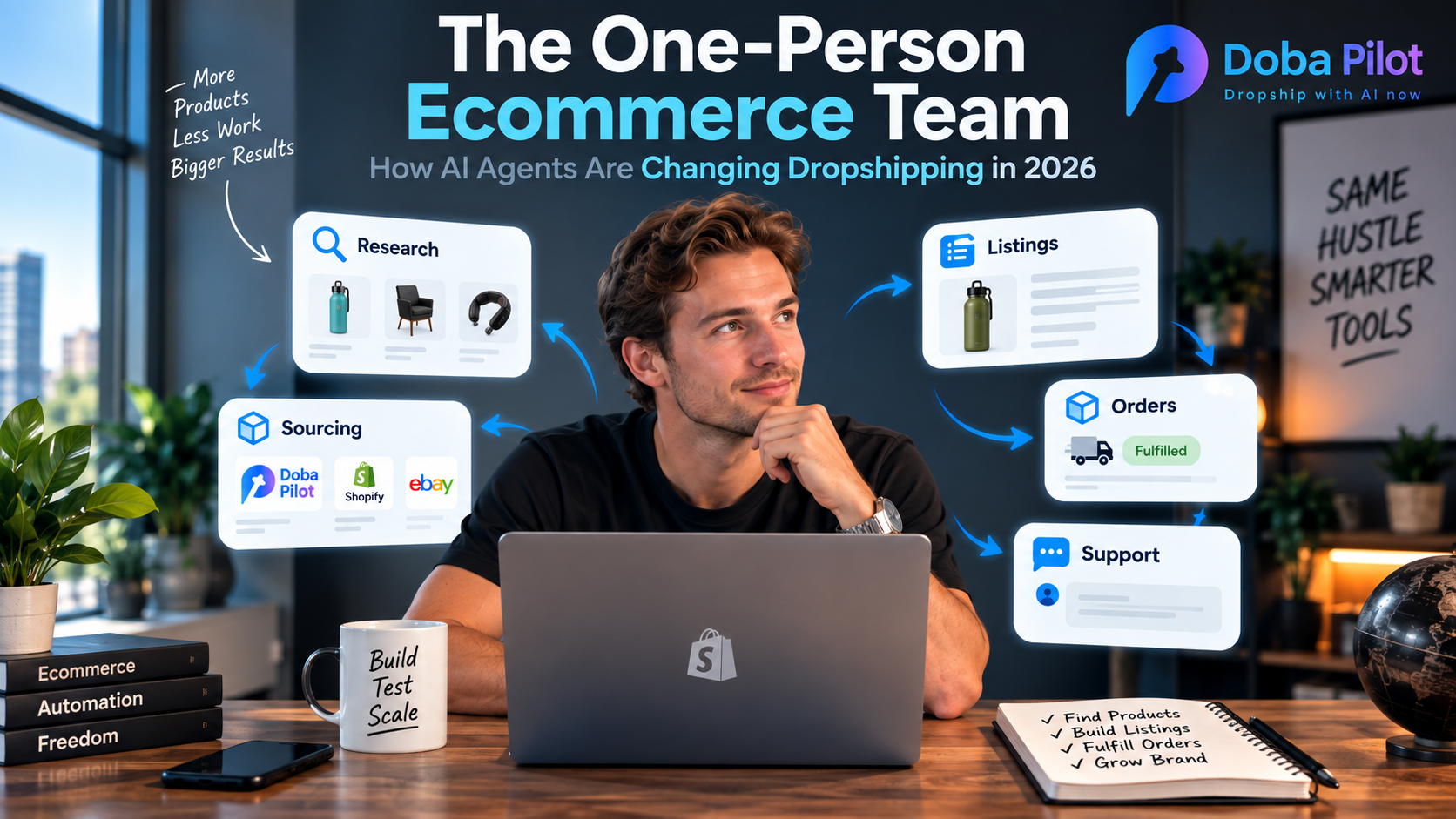
The One-Person Ecommerce Team
The One-Person Ecommerce Team
How AI Agents Are Changing Dropshipping in 2026
Most one-person ecommerce businesses do not have a motivation problem. They have a coordination problem.
The owner is the product researcher, sourcing manager, listing copywriter, pricing analyst, fulfillment coordinator, and customer-support desk—sometimes before lunch. Every job lives in a different tab. Every tool needs the same product information pasted into it again. And whenever something changes, the owner has to remember which systems need to be updated.
That is why the most useful ecommerce AI in 2026 is not another description generator. It is an agent that can carry context from one operational step into the next.
The distinction matters. A writing tool can produce a title. A connected agent can help research a market, source products that fit the brief, prepare a channel-specific listing, check an order problem, and bring the relevant details forward without forcing the seller to rebuild the context every time.
This is the idea behind Doba Pilot: one conversational operating layer built around the actual work of dropshipping. It does not remove the seller from the business. It gives the seller a better way to run it.
Ecommerce Is Growing. So Is the Operational Load.
The opportunity is not shrinking. The U.S. Census Bureau estimated $329.5 billion in U.S. retail ecommerce sales during the second quarter of 2026, up 12.4% from the same quarter a year earlier. Ecommerce represented 16.4% of total retail sales during that period.
But more opportunity also means more moving parts. A solo seller can launch on Shopify, test TikTok Shop, expand to eBay or Walmart, work with several suppliers, and serve customers across multiple channels. The storefront may look simple. The operation behind it is not.
Customer discovery is changing at the same time. Adobe reported that traffic from AI sources to U.S. retail websites grew 393% year over year during the first three months of 2026. Shopify has also moved toward native commerce across AI channels through the Universal Commerce Protocol, which covers the journey from product discovery through checkout.
For a small operator, the takeaway is not that every store needs an “AI strategy deck.” It is much more practical: products, listings, inventory, orders, and support need to be accurate and connected, because both customers and software are moving through those systems faster.
What an AI Agent Actually Means in Ecommerce
The phrase “AI agent” gets used loosely. In the most useful sense, an agent is software that can understand a goal, break it into steps, work with connected business data, and prepare or execute supported actions while preserving the context of the original request.
That is different from asking a general chatbot for ten winning products. A generic answer may sound confident, but it usually cannot see your supplier catalog, current inventory, connected stores, listing requirements, or order status. It gives advice outside the operation.
A dropshipping agent is valuable when it works inside the operation. The goal is not better conversation for its own sake. The goal is fewer broken handoffs between research, sourcing, listings, fulfillment, and support.
The useful test: Can the AI move the work forward using relevant business data, or does it simply give you another answer to copy into another tab?
The Five Seats on a One-Person Ecommerce Team
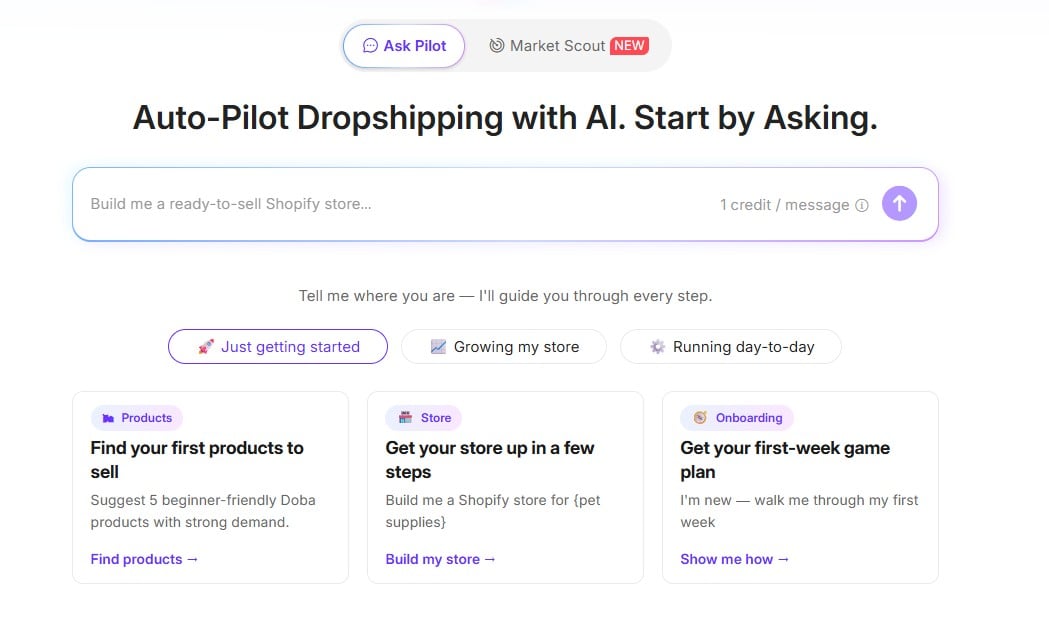
If I were evaluating an AI agent for my own store, I would not start with a feature checklist. I would ask which jobs it can reliably help me perform. Doba Pilot is easiest to understand as five operational seats that share the same context.
1. The Market Analyst: Turn a Product Idea Into a Research Question
Most bad product research starts with an answer already in mind. A seller sees one viral video, decides the product is a winner, and then searches for evidence that agrees.
Market Scout encourages a better starting point: define the market, customer, price range, geography, and season before asking for products. It can structure research around demand, competition, pricing, seasonality, and product trends, then connect promising directions to products available through Doba.
That does not turn a report into a forecast. Demand can be real and the opportunity can still fail because the margin is weak, the supplier is unreliable, or the creative angle is exhausted. The research is a filter, not a guarantee.
The important part is what happens after the report. Instead of exporting the idea into a separate sourcing tool, the seller can continue the same conversation and ask for relevant products that match the opportunity.
2. The Sourcing Assistant: Find Products That Fit the Business, Not Just the Trend
Finding a product and finding a product you can responsibly sell are two different jobs.
Doba gives retailers access to a catalog of more than one million products, including eligible U.S.-warehouse options. Pilot can search that catalog using criteria such as category, target price, warehouse preference, inventory needs, and supplier requirements.
This is where an agent can save real time: narrowing a large catalog into a reviewable shortlist. But the shortlist still needs a human decision. Before approving a product, I would verify the actual ship-from location, processing time, delivered cost, inventory, return terms, variants, product documentation, and any marketplace restrictions.
The phrase “U.S.-focused” also needs to be handled carefully. Doba offers U.S.-warehouse products; that does not mean every Doba product or every supplier is based in the United States. The product level record is what matters.
Try This Prompt |
|---|
“Find products that match this opportunity. Prioritize eligible U.S.-warehouse options, at least 100 units in stock, a realistic delivered cost below $25, and a retail range between $49 and $79. Show the supplier, warehouse, processing time, shipping estimate, variants, and major risks for each result. Do not publish anything.” |
3. The Listing Operator: Turn the Selection Into Channel-Ready Work
Anyone who has published the same product across several platforms knows how quickly “just list it” becomes a real project. Titles have different limits. Required attributes change. Variants need to map correctly. Images, pricing, descriptions, and item specifics all need review.
Doba Pilot can help configure pricing, generate or improve titles and descriptions, prepare listing information, preview the result, and publish to supported connected channels. The value is not that AI writes more words. It is that the product, supplier, pricing, and channel context stay attached to the listing task.
Doba’s August 27 update added direct listing support for Walmart and TikTok Shop alongside eBay and existing Shopify, BigCommerce, and Wix connections. For Walmart and TikTok Shop, Pilot can help complete required attributes, accept UPC uploads, generate previews, and publish multiple products in a batch. Capabilities still vary by channel, so the final preview matters.
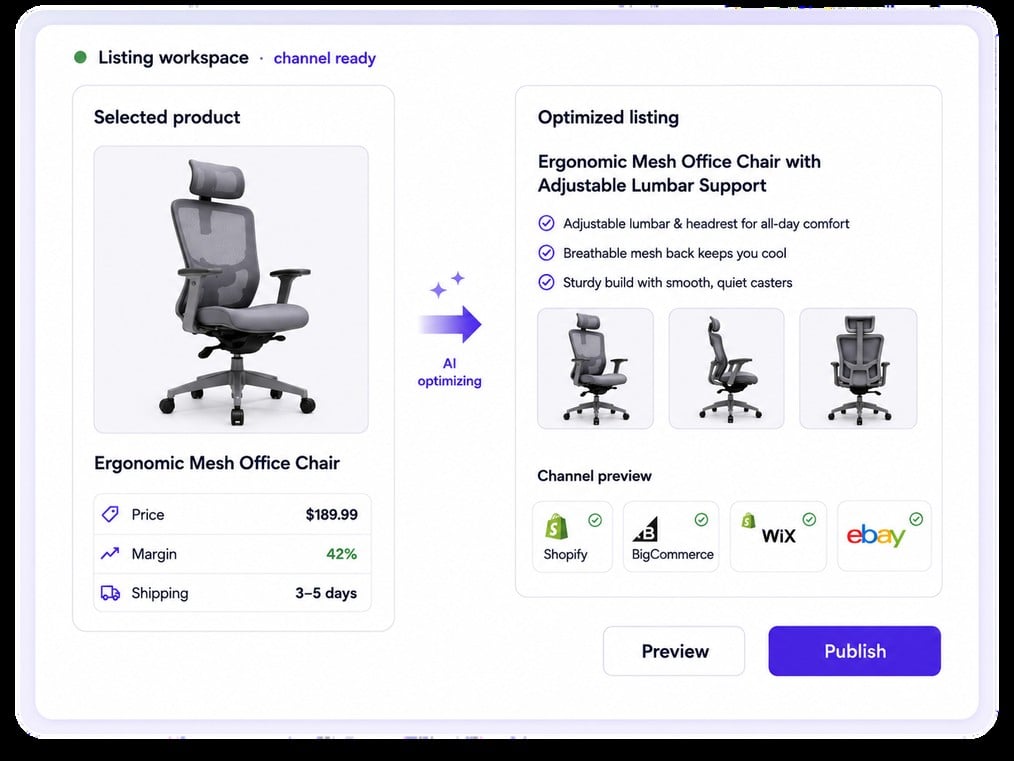
I would never publish the first AI draft without checking it. Product specifications, dimensions, materials, compatibility, claims, variant mapping, images, and total pricing all need a human pass. A faster wrong listing is still a wrong listing.
4. The Operations Coordinator: Watch the Part That Happens After Checkout
Most AI dropshipping demos stop when the listing goes live. Real businesses begin there.
Orders get delayed. Tracking numbers fail to update. Carrier pickups are missed. Customers cancel after a purchase order has already been submitted. A seller who only checks these issues reactively can lose money and trust at the same time.
Doba Pilot brings order and shipment details into the conversation, identifies fulfillment exceptions, explains what appears to have happened, and prepares practical next steps. Those next steps might include checking a pickup, contacting a supplier, updating a delivery estimate, or beginning a refund related review.
The latest Order Fulfillment Agent update can flag shipping problems and alert the seller. When an order is canceled in a connected store, Pilot can also attempt to intercept the matching purchase order if it has not shipped. Interception is not guaranteed—it depends on where the order sits in processing—and Pilot does not independently reroute, refund, or cancel an order without the seller.
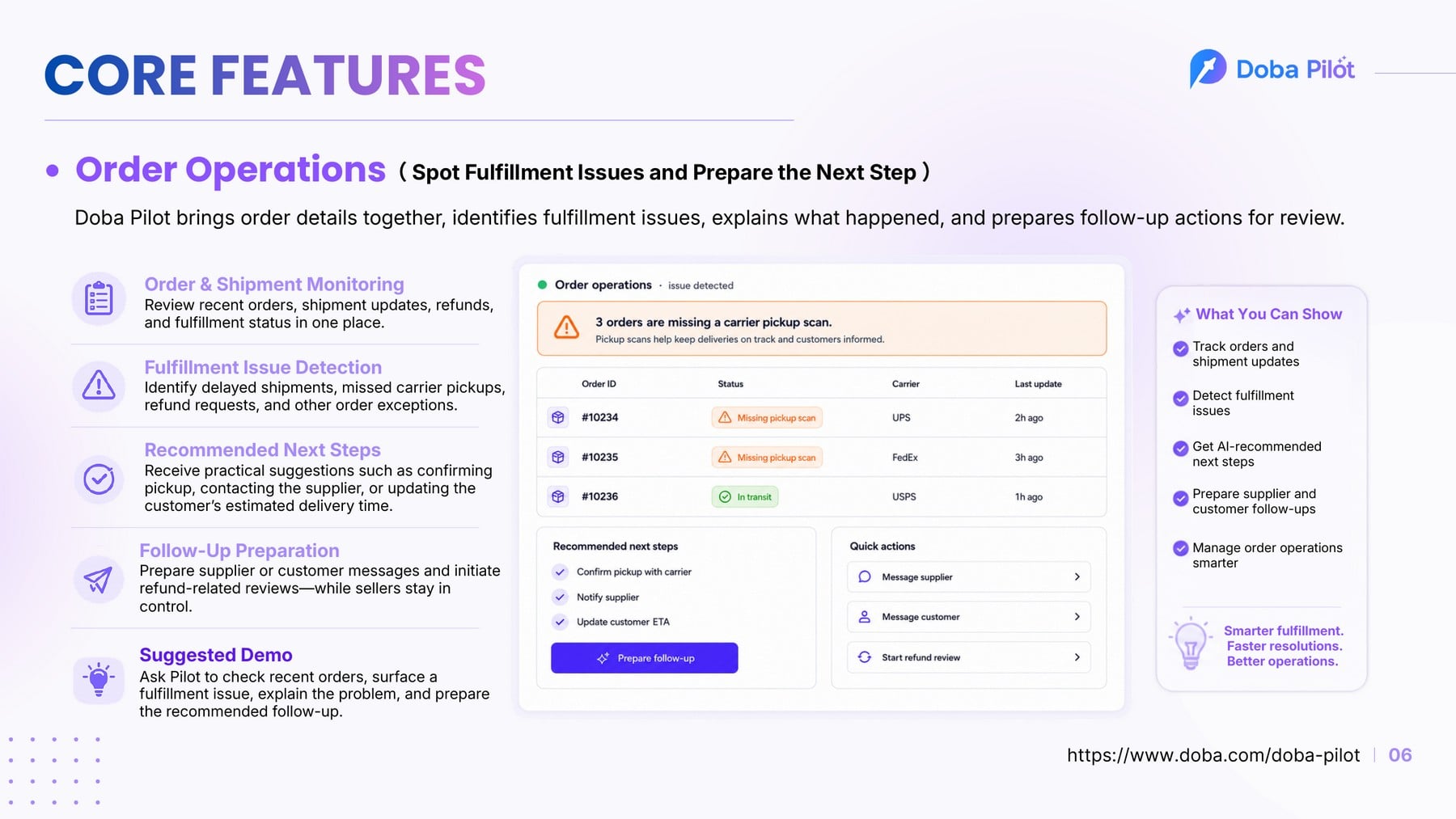
That balance is important. Automation should surface the problem early and reduce the clerical work around it. The seller should still own the decision that affects a customer, a refund, or a supplier relationship.
5. The In-Chat Support Desk: Get an Answer With the Account Context Attached
Support is another area where context gets lost. The seller opens a help center, searches for a policy, explains the same order again, and then waits for a human agent to reconstruct the situation.
Doba Pilot can answer common questions about products, suppliers, stores, orders, billing, platform rules, and operating workflows from inside the same chat. When human support is needed, the goal is a
smoother handoff with the relevant context carried forward.
This is not a replacement for every customer-service or supplier conversation. It is a first operational layer: answer routine questions quickly, organize the details, and escalate the exceptions that need a person.
Try This Prompt |
|---|
“Check order [ORDER ID]. Summarize the current status, identify any fulfillment exception, explain the likely cause, and prepare separate follow-up messages for the supplier and customer. Show me the recommended actions before taking any step.” |
What This Looks Like in One Working Session
The strongest case for an AI agent is not any single feature. It is the continuity between them. A realistic session might look like this:
1. Start with a market question instead of a product: define the audience, geography, season, price range, and problem you want to solve.
2. Use Market Scout to compare demand, competition, pricing, and seasonality. Reject weak or overcrowded directions before sourcing.
3. Ask Pilot to find matching products in Doba’s catalog. Filter by warehouse, delivered cost, stock, processing time, supplier information, and channel fit.
4. Choose one product and prepare a listing for the intended channel. Review the title, description, attributes, variants, images, pricing, and policy-sensitive claims.
5. Preview and publish only after the economics and product details survive the manual check.
6. Once orders arrive, use Pilot to check status, surface exceptions, prepare follow-ups, and answer Doba-related operating questions.
That is a more honest version of “one-person ecommerce team.” The agent does not become the founder. It becomes the connective tissue between the jobs the founder already has to perform.
What the Seller Still Needs to Own
The easiest way to ruin a useful AI tool is to use it as permission to stop checking the work. These decisions should stay with the seller:
Product judgment: Does the opportunity fit the audience, brand, and available creative strategy?
Supplier approval: Are the warehouse, processing time, inventory, product documents, return terms, and delivered cost acceptable?
Pricing: Does the margin survive shipping, marketplace fees, payment processing, advertising, discounts, refunds, returns, and taxes?
Claims and compliance: Can every health, safety, performance, material, origin, and environmental claim be supported?
Customer promises: Is the delivery estimate, return policy, and support process accurate for this exact product and channel?
Final actions: Should the listing publish, the order be canceled, the refund be approved, or the issue be escalated?
No AI can guarantee a winning product, profitable campaign, marketplace approval, or perfect fulfillment. The seller is still accountable for the promise made to the customer. The agent’s job is to make that judgment faster and better informed—not to eliminate it.
Why the Connected Workflow Matters More Than Another AI Tool
McKinsey’s 2026 global survey found that agentic AI adoption is growing, but only 22% of respondents from smaller organizations reported scaling AI agents. That gap makes sense. Small businesses rarely lack access to AI; they lack the time and infrastructure to turn isolated tools into a dependable workflow.
A seller can already assemble a stack that researches trends, writes copy, edits images, syncs inventory, tracks orders, and drafts support responses. The hidden cost is the handoff between each tool: repeated inputs, inconsistent data, lost context, extra subscriptions, and more chances for an important detail to fall through.
The better question for 2026 is not “How many AI tools do I use?” It is “How many parts of my operation can move through one accurate, reviewable system?”
That is the position Doba Pilot is trying to occupy. It combines a conversational agent with Doba’s product, supplier, inventory, store, and order data so a seller can move through Research → Source →
List → Fulfill without rebuilding the workflow at every step.
Who Doba Pilot Makes the Most Sense For
Doba Pilot will be most useful for sellers who want to reduce operational friction—not people looking for a button that guarantees sales.
- A beginner who needs a guided path from market question to a reviewed product shortlist.
- A solo Shopify, eBay, TikTok Shop, Walmart, BigCommerce, or Wix seller who is tired of repeating the same setup across tools.
- A growing operator managing more listings, suppliers, and orders than can comfortably live in spreadsheets and browser tabs.
- A multi-channel seller who wants product, listing, inventory, and order work to stay connected while retaining final approval.
It is probably not the right fit if you expect the agent to choose your brand, create demand, approve its own work, guarantee marketplace acceptance, or run a hands-off passive-income business. Those expectations are not realistic for Doba Pilot—or any serious ecommerce platform.
A Better Definition of “Solo”
A one-person ecommerce business does not need to mean one person manually touching every task.
The owner should spend time on the decisions that create leverage: choosing the market, understanding the customer, approving the product and supplier, building the offer, creating the marketing, and
protecting the customer experience. Research summaries, catalog filtering, listing preparation, routine order checks, and platform questions are necessary work—but they do not all need to consume
founder-level attention
That is the real promise of an AI dropshipping agent in 2026. Not a business without an owner. A business where the owner has more room to operate like one.
If you want to test the workflow yourself, open Doba Pilot and start with a real market question from your own niche. New users can currently register free and receive 30 Pilot Credits to explore core
features. Use the first session to research one market, source one shortlist, and review one listing—the point is to judge the workflow against your actual business, not a polished demo.
A strong first test: |
|---|
Ask Pilot to research one niche you already understand. If its demand analysis, sourcing matches, supplier details, and listing preview make your next decision clearer, the agent is doing useful work. If they do not, keep refining the brief before you automate anything. |